According to the National Waste Policy, 16.8 million televisions and computer equipment reached their “end of life” in 2007/08- of these, a staggering 84% were sent to landfill and only 10% were recycled. As Australia prepares to switch off analogue signals by the end of 2013 and switch over to digital television, this number will increase dramatically as the country begins to send a staggering amount of hazardous, electronic waste to landfill.
Kerbside Recycling & Television Collections
Recent research indicates that 90% of Australian households have access to regular kerbside recycling of materials such as plastic, paper and glass with a large majority making use of these services. However, the Australian Bureau of Statistics states that electronic waste is growing three times more than the rate of general domestic waste suggesting that Australia is in need of a similar kerbside, electronic waste collection. With the digital switch imminent, this figure is set to rise even further.
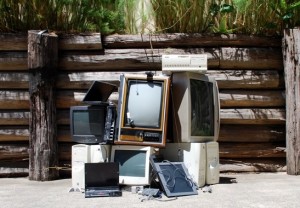
Television is a constantly evolving technology and consumers are always hungry for more.
There is no denying that digital television will be a huge breakthrough for Australian technology; it will allow those in rural areas with poor analogue signal to connect to the world through the small screen and will improve viewing and programming quality for all Australians. As a country we are further behind many European countries, as well as America, who are already well into their transition from analogue to digital.
Viewers do have the option to add a set top box to their existing television sets however, many old analogue televisions will not have the appropriate connections and, with the introduction of newer technology such as High Definition TV, many will opt for an upgrade with built in digital and HD technology. But, what will happen to these discarded televisions?
Sending your Ewaste to landfill is a waste; TV’s, like computers and white goods, can be recycled.
By throwing televisions into skip bins we are not only wasting valuable landfill space, but we’re also throwing away valuable non-renewable materials. Televisions are 98% recyclable and contain materials such as zinc, nickel and copper. All of which, through a careful recycling process, can be recovered and reused.
After much pressure from the larger electronic manufacturers, the Australian Government has agreed to implement the Product Stewardship Scheme which passes the responsibility of recycling back to the manufacturer. Under this scheme, consumers will pay a small amount on purchase and will then be able to return their ewaste to the manufacturer once the item reaches its end of life.
Too little, too late?
This innovative new programme will hopefully see an increase in electronic waste recycling but won’t be fully operational until 2011. The scheme will also only provide funding for newly purchased items and does not take into account the millions of analogue televisions that are already being discarded. It’s also too late for the 61% of Australians that have already made the transition to digital television, whose new televisions may not be protected under the proposed scheme.
According to the 2006 Consensus, there were over 7.5 million private dwellings in Australia containing an average of 22 electrical items (including white goods) per household. Taking into account population and housing growth over the last four years, Ewaste predicts that there are enough electronic items in Australian households to fill 1.3 million semi trailers – lined up that makes 17,000 km of Ewaste. To put that into perspective, that’s enough ewaste to reach all the way from Sydney to London, England. This doesn’t even begin to take into account commercial ewaste from businesses; how many more computers, printers, monitors, fax machines, phone sets, scanners and photocopiers do you think they own? And, unless the Australian Government do something to solve our growing Ewaste problem soon, the vast majority is heading for the dump…
How you can recycle your analogue televisions and other electronic goods NOW.
In the mean time, 1800ewaste is Australia’s leading ewaste collection and recycling service and we’re passionate about diverting as much electronic equipment from landfill as possible. We believe in prolonging the lifespan of valuable materials by recycling all that we can. Currently 95-98%, by weight, of all the materials we collect is recycled for future use. Our service is professional, fast and reliable; we’ll come to you, collect your Ewaste and deliver it to the appropriate recycling facility. 1800ewaste only recycles with ISO14001 accredited Australian recycling facilities.
If you’re interested in having your Ewaste recycled please give us a call today on 1800 39 27 83.